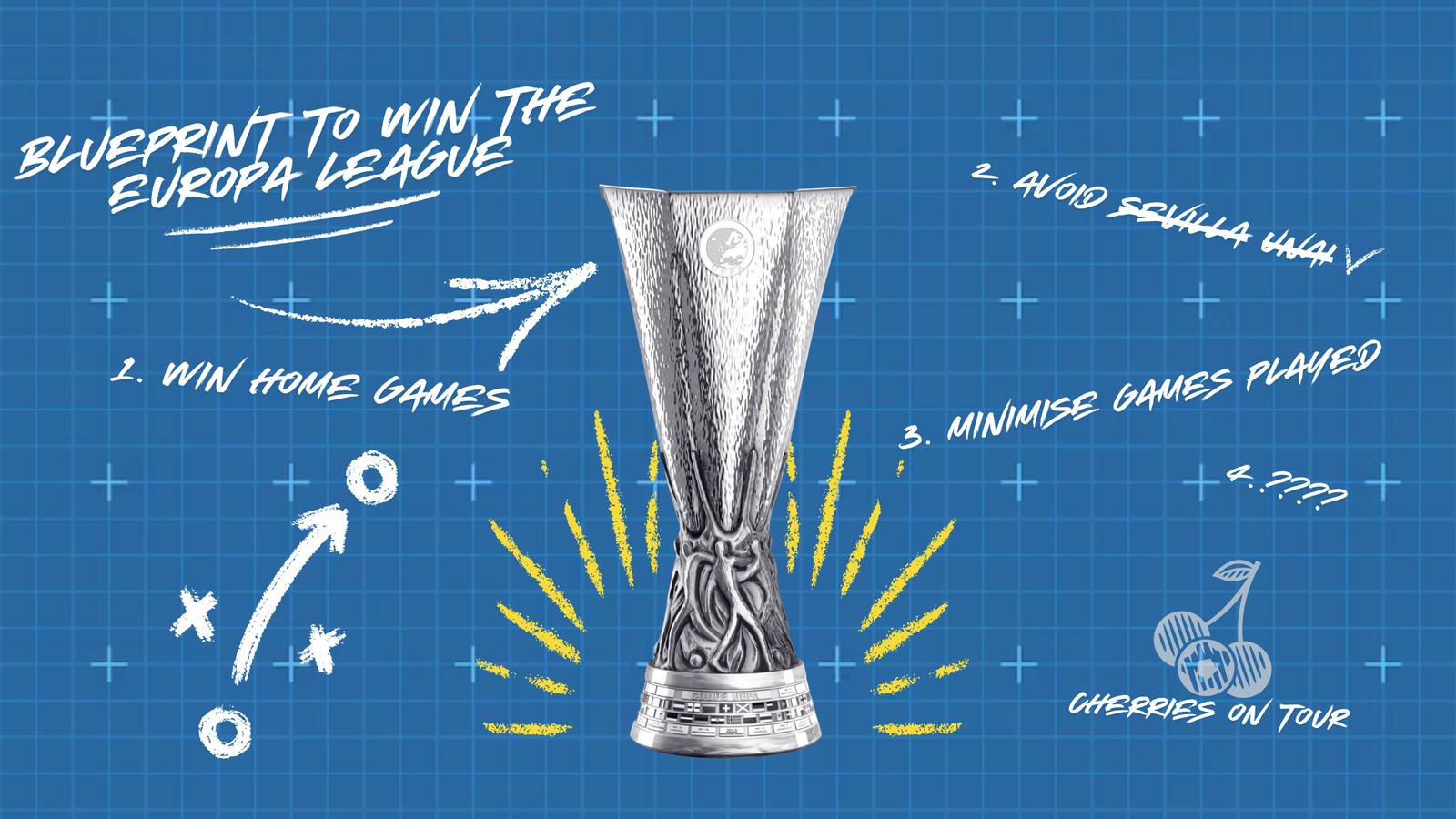
A graphic design featuring a blueprint with 'Blueprint to win the Europa League' as a header.
Jack Tanner

The blueprint for Europa League success

Pack your bags and make sure your passport is in date - Cherries are on a tour of Europe for the very first time. English clubs have found joy in UEFA’s secondary competition in recent years - so what is the blueprint Cherries need to follow for success in their debut outing?

08.08.26, 00:43 Updated 10.08.26, 18:59 8 Minute Read

Jack Tanner

Jack Tanner

Cherries are set to embark on their first season competing in Europe, a sentence that brings me great joy to write and hopefully to you reading it. Just rubbing shoulders with such names as Juventus, Milan, and Marseille is exciting enough, but the prospect of a deep run in the competition does not seem too far-fetched. 

The Waldstadion in Frankfurt is the destination of the 2026-27 UEFA Europa League final. How exactly do Cherries plan on reaching the showpiece game? These recent trends may form a blueprint to follow for Europa League success.

Make your house a fortress

The ever-changing format of the competition makes direct comparisons difficult, but a clear trend remains. The best sides stay unbeaten during their home games.

The eight-game league phase and two-legged knockouts means that you can afford to drop a game or two on the road - without making a habit of it - if you win your games on your own turf.

Nine out of the last 10 winners have all remained unbeaten at home.

Stretching that to include the runners-up, just three teams in total made the final whilst losing at home. 2024 winners Atalanta lost one knockout game in front of their own fans, whilst finalists Roma and Rangers, in 2023 and 2022 respectively, lost one group stage fixture.

A strong enough home record can even paper over the cracks of a shoddy time on the road.Sevilla lifted the trophy in 2023 without winning a Europa League game as an away team. 

Only one winner in the past decade has had a better away record than their home form - Eintracht Frankfurt in 2022, who simply went unbeaten throughout the tournament. That’s definitely a good way to do it, I suppose.

Avoid extra time and penalties

If you view penalty shootouts as a lottery, or at least a great leveller between teams, you won’t be surprised to hear that the most successful sides in the Europa League tend to avoid the dreaded spotkicks - and extra time as a whole.

Just one finalist in the last three seasons has required extra time at any stage of their run to the last two. That was 2025 runners-up Manchester United, who required another 30 minutes only once.

Over the last 10 seasons and 46 ties, the eventual winners have had to rely on extra time a combined seven times.

Looking just at penalties, champions over the past decade have gone to spotkicks just four times, with three shootouts occurring in the final.

2019 winners Chelsea are the only winners in the last 10 iterations to win a shootout prior to the final - beating Eintracht Frankfurt on penalties at the semi-final stage.

Minimise games played

Qualifying directly for the Europa League proper is a huge boon. In the last 10 years, only Rangers have reached the final after entering the competition at the qualifying stage.

Cherries enter the competition in the league phase, but they can still limit the amount of ties they have to contend with. That’s because the top eight teams after the league fixtures advance straight to the round of 16 - while teams ranked ninth to 24th face each other in an additional knockout round.

Two extra games feature more travelling, and heightened risk of injury and suspension. 

Although it is a small data set, six of the eight semi-finalists so far in the current format qualified for the round of 16 without the rigmarole of navigating another knockout tie. None of the finalists have messed around with the knockout play-off since the latest changes to the competition.

Use the entirety of your squad

The last three winners of the Europa League have used at least 29 players at some stage of the competition, demonstrating that it truly is a team game. Premier League sides are well aware of the need to rotate, but playing in Europe takes that requirement to another level.

On top of the extra games sandwiched in between frenetic domestic fixtures, travelling large distances impacts players’ ability to recover. That’s why Aston Villa (29 players), Tottenham Hotspur (30) and Atalanta (32) used the full depth of their squad en route to victory.\

The eagle-eyed amongst you will quite rightfully detect that those numbers are higher than the 25-man squad limit implemented by UEFA for the Europa League.

Whilst some squad’s players-featured count was increased by winter transfers, new signings replacing outgoing footballers, most of the added extras are accounted for by other means.

Successful Europa League managers have looked beyond the first team to bolster the squad, handing youth players their chance on the continent. Players under the age of 21 that have spent two years at a club’s academy do not need to be registered, explaining how the limit of 25 can easily be surpassed with some talented youngsters.

That’s something Cherries will have to carefully consider when finalising their squad - they currently are unable to register the maximum of 25 players, lacking the required home grown players over the age of 21 to satisfy Europa League rules.

That could be a rather large hurdle for Cherries to contend with.

There has only been one outfield player in the last five campaigns to have played every single minute of their side’s run to the final - SC Freiburg defender Matthias Ginter last season.

Two goalkeepers have also achieved the feat, but only seven out of 261 players that helped their club reach the final featured in every single game. Just five of that crop started in every single match, highlighting how even the most crucial of players need some rest during the course of the campaign.

Represent England

There was once upon a time where English clubs seemingly binned off their European duties in the UEFA Cup to focus on qualifying for Europe via the Premier League. As evidenced by the English co-efficient, this flawed logic is thankfully no longer followed.

Aston Villa’s triumph last campaign saw the Villans become the sixth English side to lift the Europa League. Four English clubs have reached the semi-finals in the last two seasons, with two of those sides winning the competition - the aforementioned Villa and Tottenham Hotspur, the first-ever champions of the UEFA Cup.

In total, English teams have claimed the trophy on 11 occasions. Combined with nine runners-up, no other nation has had more finalists than England - although Spain boasts the most trophies, with five clubs winning 14 trophies between them.

Out of 35 clubs to represent England in the Europa League, 14 sides have reached at least the semi-final stage - well over a third of teams.

Evade Sevilla - and Unai Emery

Everybody knows that the Europa League is Sevilla’s playground, the southern Spanish outfit winning the competition seven times under its different guises and formats.

There’s another Europa League-lover from Spain, with Basque boss Unai Emery lifting the trophy on five occasions - three times with Sevilla, and once apiece with Villarreal and Aston Villa.

Fortunately, Cherries have already satisfied this requirement. Sevilla failed to qualify for the competition, and last year’s winners, Villa, are playing Champions League football.

Bournemouth fans can breathe a little bit easier knowing that sides can no longer drop down from Europe’s elite club competition and into the secondary tournament - just as Sevilla did en route to success in 2023 and 2016.

Have previous experience in the competition

We’ve appeared to have stumbled upon a hitch to our blueprint. Despite theoretically being a competition where clubs outside of Europe’s elite should thrive, the Europa League has been a fairly closed shop. 

We’re not just talking about Sevilla. In the competition’s 55-year history, only 31 clubs have won it - 14 of which have won it on multiple occasions. Quite often you will have a big name from one of Europe’s top five leagues entering the competition off the back of a disappointing league season, but beyond the elite clubs, there are plenty of sides boasting European experience.

A debutant has not reached the semi-finals of the Europa League since 2004, when future winners Villarreal lost to compatriots Valencia.

New teams very rarely breach the final four - Villarreal were just the second to do so in the 21st century, following in the footsteps of fellow Spaniards Deportivo Alaves who lost the 2001 final 5-4 to Liverpool.

To find the last time a debutant lifted the trophy you’d have to go all the way back to 1973, when Liverpool won the second edition of the UEFA Cup. That’s right - since 1973 every winner of the Europa League and its predecessor, the UEFA Cup, had previously entered the tournament at least once before winning it.

In total there have been 108 different sides that have reached the semi-final stage. Even including the inaugural season, on average it roughly takes a side five attempts to make the final four for the first time.

Out of those 108 teams, only eight reached the semi-finals in their debut Europa League campaign, with just two of those teams making the final.

On average, it takes a club almost six attempts to win their maiden Europa League.

In the last 50 years no side has won the Europa League, nor the UEFA Cup, in their first year of participating in the tournament. Then again, no one ever expected AFC Bournemouth to be playing in Europe. 

Could you truly write off Cherries’ chances of making even more history?

Related Topics

Jack Tanner

Jack Tanner Starting his journalism career covering local non-league football at the age of 14, Dorset-native Jack Tanner covered Cherries for the Bournemouth Daily Echo for the best part of four years. After a brief stint covering AFC Bournemouth on a freelance basis for national newspapers, Jack went on to cover boxing for The Independent.

More like this

Get started with our free newsletter

Sign up to receive your free newsletter with articles and analysis from our team

By entering your email address you agree to our Terms of Use and Privacy Policy and consent to receive emails from Cherries On Top.